

Everything you're wondering
about VR therapy, answered.
Honest, specific answers about getting started, your sessions, what we treat, safety, the evidence, and the practical details, from booking to billing. Can't find it here? Call us at 647-224-5900.
Barrie, Ontario · No referral required · 51 questions across 6 categories
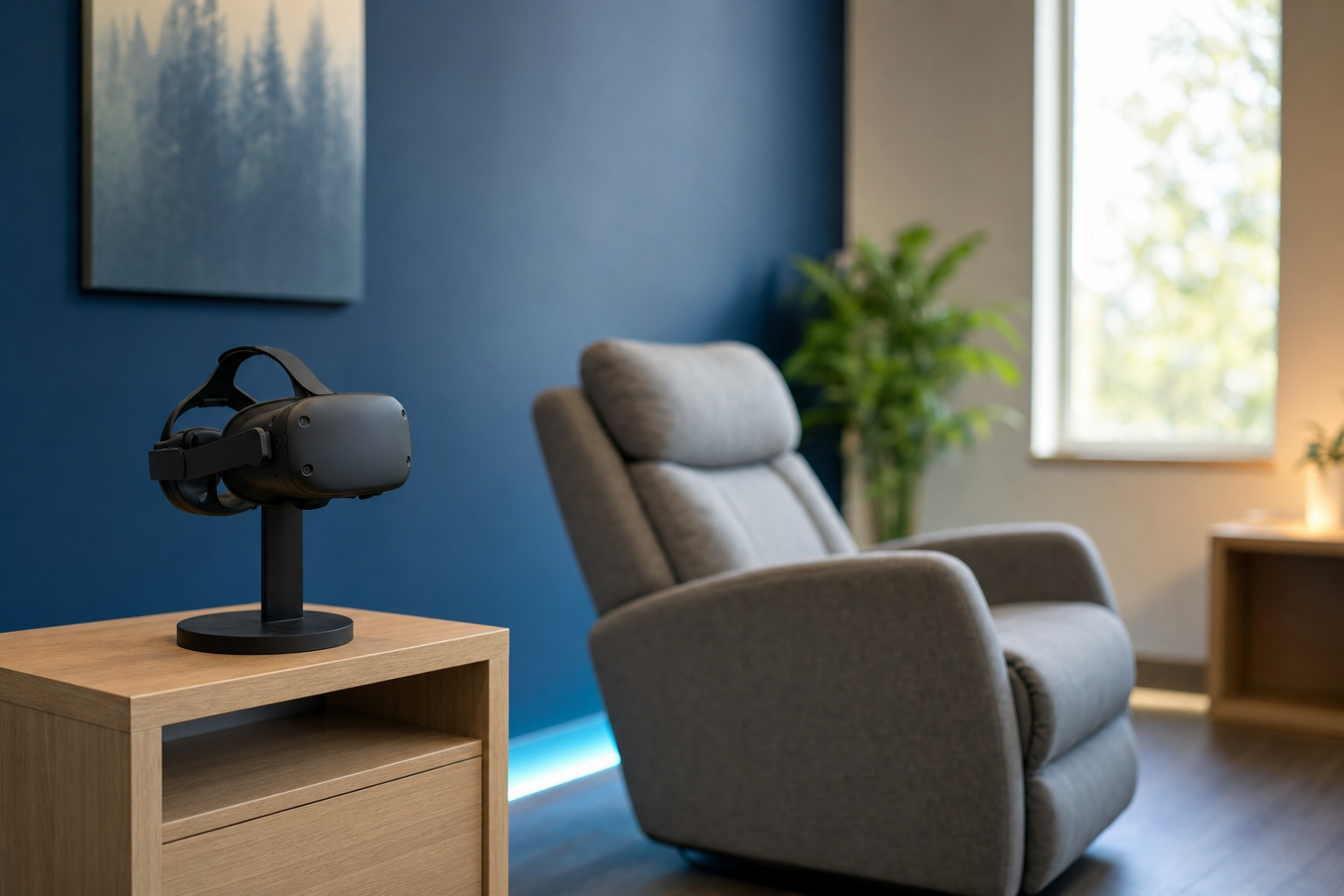
Illustrative rendering of a supervised VR therapy session setup, not a photograph of the actual premises.
Find your answer.
Filter by category, then select any question to expand it. Every answer is grounded in our published pricing, protocols and the vendor research we cite. Nothing here is guesswork.
8 Getting started
Virtual reality (VR) therapy uses an immersive headset to place you inside an interactive, three-dimensional environment as part of a structured therapeutic session. Depending on your goals, that might mean a calming distraction environment used alongside pain care, a graded exposure scenario used for anxiety or a specific phobia, or an engaging activity used to support rehabilitation or memory care. At Better Relief VR every session runs on one of two certified platforms, Mynd Immersive for pain, aging and rehabilitation, or PsyTech VR for anxiety, phobias and trauma, and is supervised in-clinic by a certified technician from start to finish.
No. Better Relief VR is a self-referral clinic. You can book directly without a referral. If you already have one from a physician, physiotherapist or other provider, bring it along; it can help us tailor your programme and may be useful if you plan to seek reimbursement through an extended health plan.
Book online through our booking page, or call us at 647-224-5900. Every new client starts with an initial clinical assessment before any therapy sessions are scheduled. See our pricing page for current fees.
The assessment is an extended visit where a certified VR Therapy Technician reviews your health history, discusses what you're hoping to achieve, screens you for the contraindications listed on this page, and selects the platform and protocol that best fits your situation. It's also your chance to try the headset briefly and ask questions before committing to a full programme.
This varies by person and by condition, and we won't promise a specific timeline. Our published protocols run over several sessions. For example, 8-12 sessions for chronic pain, 6-12 for mental health support, 6-10 for physical rehabilitation, and 4-8 for cognitive engagement and geriatric care, with a review built in at the end of each block so you and your technician can judge whether it's working for you. See the evidence section below for what published research reports, which is not the same as a guarantee for your individual case.
Every client begins with the initial clinical assessment, which includes a brief hands-on introduction to the headset. Whether a single therapy session makes sense on its own, versus starting a multi-session block, is something to discuss with your technician at that assessment. It depends on your goals and the condition being addressed.
We haven't published a general age policy, and we don't want to guess one here. If you're asking about a child or teenager, please call us at 647-224-5900 so we can talk through suitability, screening and consent requirements directly.
See the conditions section below, or visit our services page for a fuller breakdown of each service line.
9 Your sessions
Standard VR therapy sessions are 45 minutes. The initial clinical assessment is a longer, extended visit. Ask at booking for its expected length.
Wear comfortable clothing you can move in, especially for rehabilitation-focused sessions. Avoid anything tight or bulky around the head and ears that might interfere with the headset fit, and let your technician know before the session if you wear glasses or hearing aids so they can adjust the fit properly.
Most sessions are done seated in a therapy chair for safety and comfort, particularly for pain, mental health and cognitive engagement programmes. Some rehabilitation activities may involve supervised standing or movement where appropriate to your goals. Your technician will always set this up in a way that matches your mobility and comfort level.
Yes, at any time and for any reason. Your certified technician is monitoring the session throughout and can pause or end it immediately if you feel unwell, want a break, or simply want to stop. You are always in control of the headset experience.
Yes. Every session is supervised in-clinic by a vendor-certified VR Therapy Technician from start to finish. You are never left alone in the headset.
Tell your technician immediately, or simply remove the headset. You can do this yourself at any time. Technicians are trained to recognise adverse reactions and to pause or stop a session as needed. See safety and suitability below for who should be cautious about VR generally, including cybersickness.
Our certified technicians are trained in equipment hygiene as part of their vendor certification, which covers cleaning protocols between uses. For the specifics of our current cleaning routine, ask your technician at your visit or call 647-224-5900.
This is worth discussing at your assessment, since it depends on the type of session and, for programmes like dementia or memory care, may actually be encouraged. Let us know your preference when you book, or call 647-224-5900 to ask ahead of time.
Modern clinical VR headsets are designed to be worn for session-length periods, and your technician will adjust the fit for you before starting. If anything feels uncomfortable, whether the straps, the weight, or the fit over glasses, say so. It can usually be adjusted right away.
10 Conditions treated
We deliver four service lines built around two certified platforms. Chronic pain management (lower back pain, musculoskeletal pain, neuropathic pain) and physical rehabilitation (orthopedic and neurological recovery) run on the Mynd Immersive platform, alongside cognitive engagement & geriatric care (elderly cognitive stimulation, balance, connection). Mental health support (anxiety, stress-related disorders, PTSD-adjacent presentations) runs on the PsyTech VR platform. See the full list in the conditions filter below.
Our chronic pain management service line targets lower back pain, musculoskeletal pain and neuropathic pain. The typical protocol is an assessment followed by 8-12 supervised sessions plus a maintenance session as needed, delivered on the Mynd Immersive platform.
Our physical rehabilitation service line supports orthopedic and neurological recovery. The typical protocol is an assessment followed by 6-10 sessions plus a progress review, delivered on the Mynd Immersive platform.
Our mental health support service line addresses anxiety, stress-related disorders and PTSD-adjacent presentations. The typical protocol is an assessment followed by 6-12 sessions plus follow-up, delivered on the PsyTech VR platform, which also covers social anxiety, specific phobias, depression, OCD, addiction and cravings, and autism social skills.
This service line supports elderly cognitive stimulation, balance and connection, including dementia and memory care, Parkinson's engagement, and reducing isolation and loneliness. The typical protocol is an assessment followed by 4-8 sessions plus a caregiver review, delivered on the Mynd Immersive platform.
Yes, on the PsyTech VR platform, which offers a library of 150+ evidence-based phobia scenarios (PsyTech VR) alongside protocols for generalised anxiety, social anxiety and panic. Sessions use graded exposure with the intensity controlled by your technician throughout.
Yes, mental health support on the PsyTech VR platform covers PTSD-adjacent presentations using structured, clinician-paced exposure work. This complements, rather than replaces, any trauma therapy or medical care you're already receiving.
Yes, through our cognitive engagement & geriatric care service line on the Mynd Immersive platform, which includes reminiscence-style experiences designed to support memory care, along with Parkinson's engagement activities and programmes to reduce isolation and loneliness.
Calm, focused engagement delivered through the Mynd Immersive platform is used to help settle agitation and restlessness, including sundowning-type episodes, as part of our cognitive engagement & geriatric care service line.
Yes. Chronic pain affects roughly 19% of Canadian adults, with higher prevalence in the 40+ age group, and it's one of the primary reasons clients come to our clinic. If that's you, our chronic pain management service line is the right place to start; ask about it at your assessment.
10 Safety & suitability
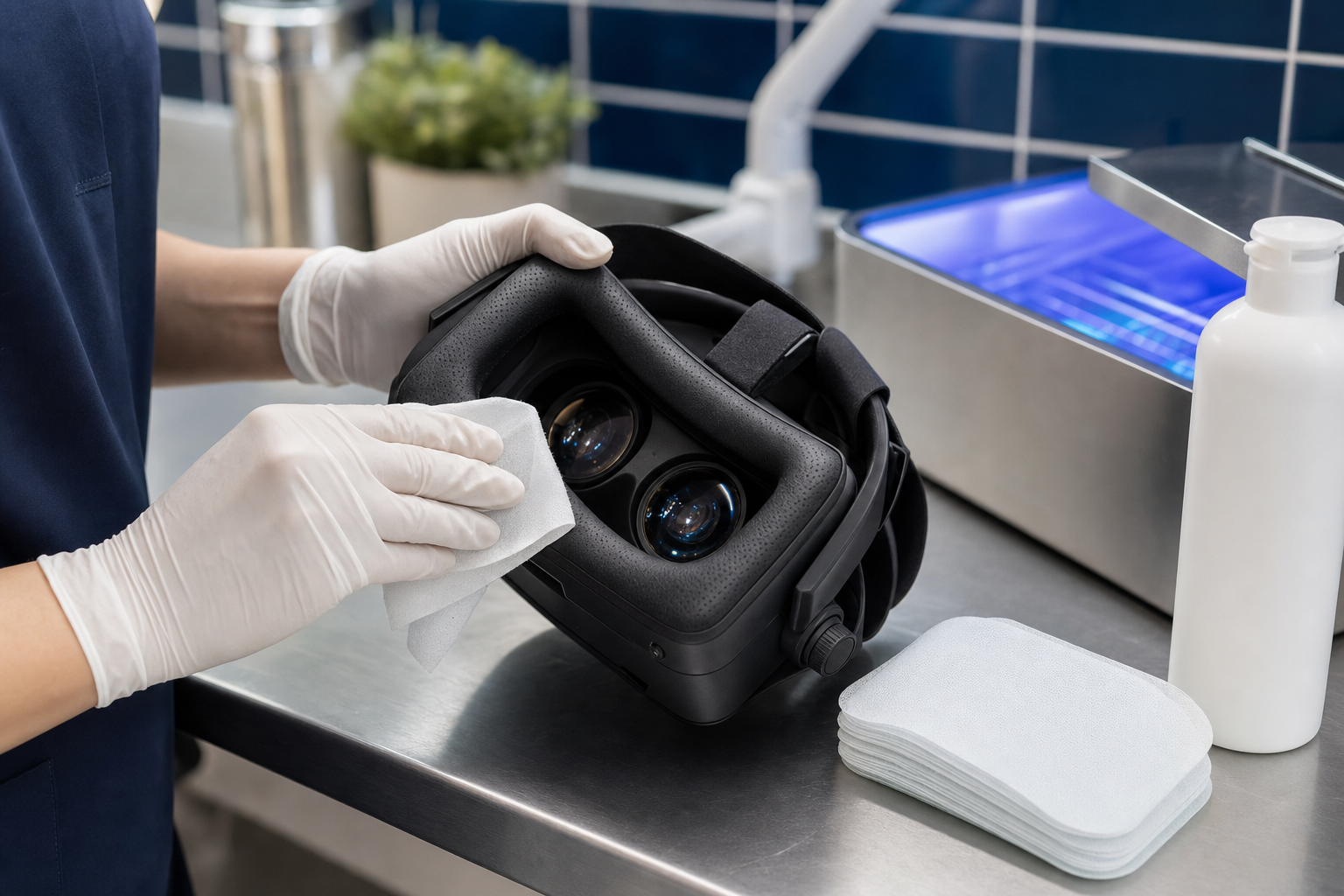
Illustrative image of headset hygiene practice between clients, not a photograph of the actual premises. Every session is screened for the contraindications below.
VR headsets carry some known risks that we screen for at every assessment, listed below. Within those limits, sessions are supervised throughout by a certified technician who can pause or stop at any time. VR complements your existing medical care. It is not a replacement for it, and it is not right for everyone.
This is a contraindication we screen for. People with epilepsy or photosensitive seizure disorders should not use VR headsets without first discussing it with us and, ideally, their physician, since some VR systems can trigger seizures. Please mention this when you book so we can talk it through before your assessment.
Severe motion sensitivity or vertigo that makes it hard to tolerate a headset is a contraindication we screen for. Mild sensitivity is common (see the cybersickness question below) and can often be managed, but if you have a diagnosed vertigo condition, tell us at booking so we can assess suitability before you start.
No. Active psychosis, or any condition where it may be difficult to reliably distinguish the virtual environment from reality, is a contraindication. We screen for this at assessment. If this applies to you or someone you're booking for, please call us at 647-224-5900 to discuss first.
We don't have a published clinic policy on this, and we'd rather you get a straight answer than a guess. Please raise it at booking or call 647-224-5900. We can talk it through and, where appropriate, suggest checking with your physician first.
Usually not. Let your technician know before your session so they can fit the headset around glasses or adjust for hearing aids. Mention it at booking too, so we can plan for it.
Many of our programmes are designed to be done seated, and rehabilitation activities are tailored to your current mobility rather than a fixed standard. Tell us about any mobility limitations at booking so your assessment and protocol can be planned around them from the start.
Cybersickness refers to nausea, dizziness or disorientation that some people experience in VR, similar to motion sickness. It affects some users and typically eases as the session ends or the headset is removed. Using high-quality, low-latency headsets helps reduce the risk (PsyTech VR), and your technician can pause or stop your session immediately if you feel unwell.
We haven't published a fixed minimum or maximum age. Suitability is assessed case by case at the initial visit. If you're asking on behalf of a child, teenager, or an older adult with complex health needs, call 647-224-5900 and we'll talk through it directly.
This is worth flagging before you book. Manufacturers generally advise caution using VR headsets for people with an electronic medical device such as a pacemaker, or a history of seizures. Tell us about any implanted device when you book so we can check suitability before your assessment.
6 Evidence & expectations
The figures we publish are drawn from studies run by our platform vendors and their research partners, not from outcomes measured at Better Relief VR. For example, Mynd Immersive reports a 47% average reduction in pain intensity (DVPRS) and a 60% average reduction in distress (SUDS) from U.S. VA VISN 4 data (source), and a 37.39% average anxiety reduction (STAI-S-5) across nine Pennsylvania VA medical centres (source). PsyTech VR reports that 90% of participants in a University of Georgia study of 45 people preferred VR exposure to traditional therapy (source). Read the full disclaimer below. Individual results vary and these are not guarantees.
These are vendor-published study results, not a promise about your outcome. They don't show that VR therapy works the same way for everyone, that results are permanent, or that it replaces medication, surgery or ongoing medical care. They also don't come from independent, third-party audits of Better Relief VR's own clients specifically.
No. VR therapy is a tool for managing symptoms and supporting function alongside your existing care. It is not marketed or delivered as a cure for any condition.
No. VR therapy is designed to complement your existing medical care, not replace it. Keep taking medication as prescribed and stay in touch with your physician or specialist; we're happy to share progress notes with your care team on request.
No. To be direct about this: neither of the platforms we use, Mynd Immersive or PsyTech VR, holds a Health Canada medical device licence. PsyTech VR holds an FDA establishment registration (Owner/Operator 10095803, Listing D598351), which is a facility listing, not a clearance or approval of any kind. We think it's important you know exactly what that does and doesn't mean before you book.
We deliver programmes built by two established VR platform vendors, Mynd Immersive and PsyTech VR, as a certified in-clinic provider; we are not the developer of either platform. If a programme isn't working for you, tell your technician: protocols are reviewed at set points (for example, after a chronic pain block or at a progress review), and we can adjust, pause or stop your plan based on how you're responding.
8 Practical & payment
We're at Unit 207, 1 Quarry Ridge Rd, Barrie, Ontario L4M 7G1, inside the Royal Court Medical Centre, directly adjacent to Royal Victoria Regional Health Centre (RVH). We serve clients across Simcoe County and the surrounding area.
We haven't published specific parking details here. Call 647-224-5900 or ask when you book and we'll walk you through the best place to park at the Royal Court Medical Centre.
We haven't published our current hours on this page. Please check availability when you book online at /book/, or call 647-224-5900 for our current schedule.
Bring photo ID and, if you plan to seek reimbursement, your extended health insurance information. A list of current medications and any recent, relevant medical reports are helpful but not required. Wear comfortable clothing. See your sessions above for details.
We haven't published a specific cancellation window here, so please don't assume one. Confirm the cancellation terms when you book at /book/ or by calling 647-224-5900, and check your confirmation for details.
Full current pricing, including the initial assessment, single sessions, our 5-session block and follow-up sessions, is on our pricing page. Better Relief VR is a private-pay clinic.
Better Relief VR is private-pay. We don't bill OHIP, and we can't guarantee reimbursement from any insurer. Many extended health benefit plans do reimburse some services, so it's worth checking your own plan's coverage for virtual reality therapy, physiotherapy-adjacent or mental health services. We can provide a receipt for any session so you can submit a claim yourself.
Only with your consent. Our technicians are trained in PHIPA-appropriate documentation, and we're glad to share progress updates with your family physician or other care providers if you'd like us to. Just let us know at your assessment.
No questions in this category yet. Call 647-224-5900 and ask us directly.
Please read this carefully. Efficacy figures on this page are published by the platform developers (Mynd Immersive and PsyTech VR) and their research partners, and describe those studies, not outcomes measured at Better Relief VR. Individual results vary. Virtual reality therapy is used to complement your existing medical care; it does not replace medication, surgery or advice from your physician. Neither platform holds a Health Canada medical device licence. VR is not suitable for everyone: people with epilepsy or photosensitive seizure disorders, severe vertigo or motion sensitivity, or active psychosis should speak with our team before booking.
Two certified platforms.
Mynd Immersive
Used for our chronic pain management, physical rehabilitation, and cognitive engagement & geriatric care service lines: distraction-based pain support, goal-based rehab activities, and reminiscence and engagement work for memory care.
PsyTech VR
Used for our mental health support service line: clinician-controlled, graded exposure therapy for anxiety, specific phobias, PTSD-adjacent presentations, depression, OCD, addiction and cravings, and autism social skills.
Book an assessment and ask us in person.
If you didn't find your answer here, call us at 647-224-5900 or book your initial assessment. Every plan starts with a real conversation about your situation.
Barrie, Ontario · 647-224-5900 · No referral required